I found myself walking on a stone path. Walking on a stone path, I found myself
Traveller, there is no path,
The path is made by walking.
Antoni Machado[i]
Haunted by a chronic sense of unease and by nightly visitations of bewilderment, the conclusion I’ve come to in recent months is that my disquiet is simply that of being human (disoriented and misplaced) in a modern world.
I have lost my way.
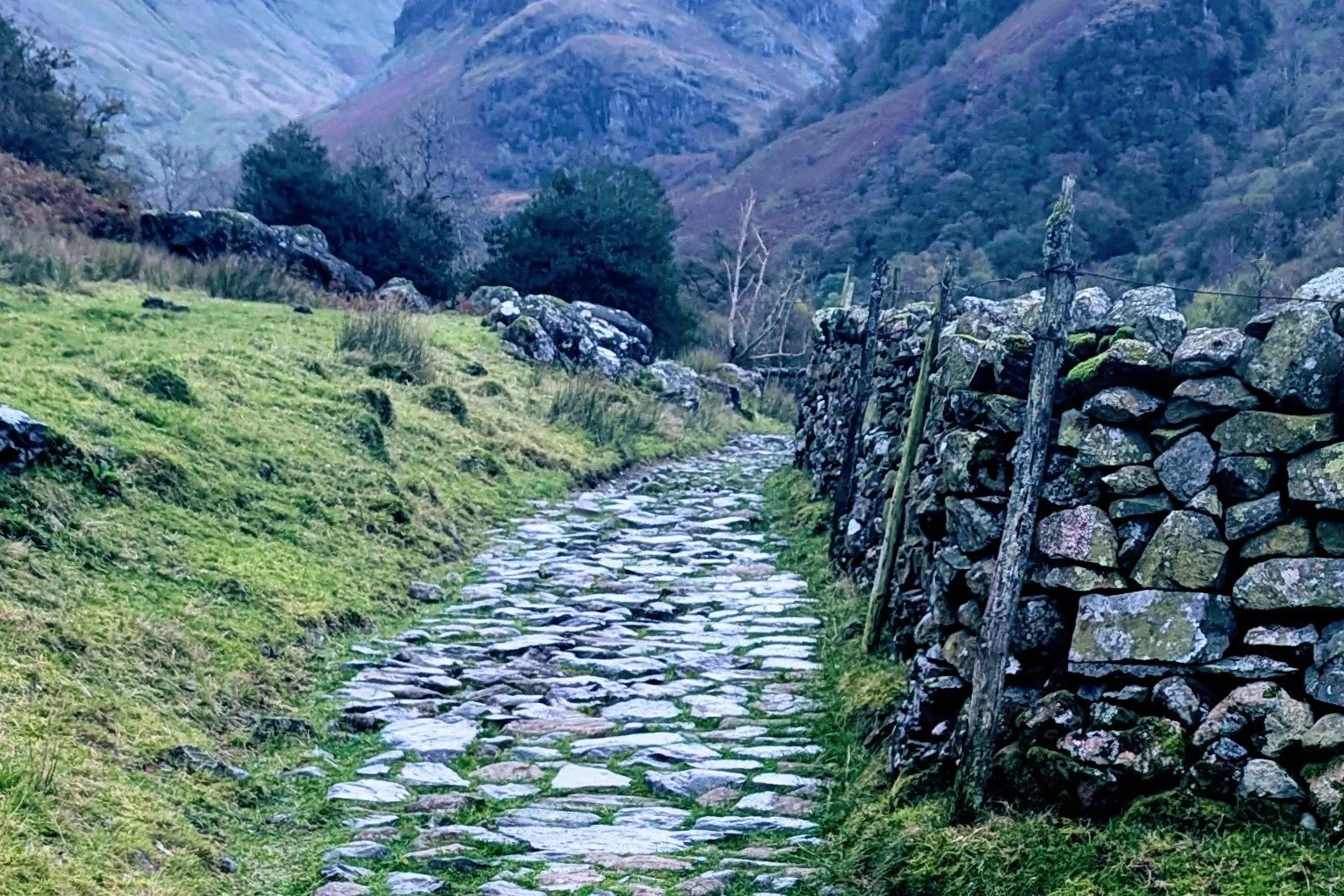
Or so it seemed, until I found myself walking a stone path heading out of the tiny lakeland hamlet of Rosthwaite, as dawn blushed over the brow of surrounding fells, heralding the imminent arrival of Storm Boelo.
The moment my feet stepped onto the ancient stones and my eyes set upon its winding way, I noticed a softening of heart, an expansion of breath, and a visceral sense of re-membering, like an explosion in rewind where all the pieces fly back into a single coherent shape.
I found myself walking on a stone path. Walking on a stone path, I found myself[ii].
* * *
I found myself in the embrace of curvature. Behind me, beneath and ahead of me lay a curving, twisting, winding, arching, looping, coiling, bowing, and undulating path. A riddle of irregularity, devoid of straight lines. A perplexity of singular shapes which somehow manage to fit together into tracks and boundaries that have stood the test of flood, storm and frost over many hundreds of years.
Armed with simple handheld tools, the Cumbrian kin who made these ancient ways and walls followed the lie of the land, bending here around the ancient oak tree, and looping back there to follow the crook of the moorland beck. The imprint of hand and foot and eye lie thick upon these stones. The thrusting insistence of engine, machine and mechanism is nowhere to be seen. The technology is stone age.
Heading towards the craggy uplands of Grasmere Common, the path dips in and out of sight, swallowed into the belly of the dale, only to reemerge over the next brow, like a great whale diving and surfacing from the deep. There is something delicious about this game of hide and seek. I trust the path. Though it hides from my sight, I know it is still there. I know it is waiting for me. I feel like a child being thrown into the air by a loving father. I know the path will catch me – always.
So why is it so very much harder to trust the path that winds and coils its way through the inner landscape of my life? When the way ahead seems lost (as it does now), why can I not trust that the path within is waiting for me to reach the brow or turn the corner; waiting with open arms ready to gather me up once more and lead me on.
How did I lose faith in the lie of the land?
* * *
It seems that I have been hoodwinked by the false promises of modernity, with its blind faith in a world that is altogether mapped out, and its insistence that the way ahead is plain for all to see. I have bought into the notion that the path is the product of my will alone, of my conception and striving, as though I were a spider spindling a thread out of my own body. So when I lose sight of the way, I believe there must be something wrong with me.
Walking this winding path through the timeless Borrowdale valley, I remember that the path running through me also follows the lie of the land, refusing to be bound by the efficiency of straight lines. The path within appears and disappears. It bends here around the roots of a storm-struck wound, loops back there around the crook of a forgotten childhood memory, all the while refusing to cut across the landscape of my life. The path is endlessly patient. It will take its time to find a way, all the while honouring the confluence of paths that weave the larger story, within which I am a but a small grassy lonning[iii].
My path is made of stories, steps and stones. It does not reveal itself all at once, rather it unfolds in time. I cannot skip ahead to see the way in its entirety, for my path is a living thing, both ancient and brand new, which unfolds as the context shifts and turns around me. I must experience it step-by-step from the beginning, or perhaps through my beginning, for the path I walk has its origins in the deep time of rock and stone.
‘What is the difference between a rock, a stone, and a boulder?’ my son asks. We agree that they are all made of the same stuff, but that each has a different story (no two stones are the same), a story which unfolds through time. And time is what modernity refuses to give us. Time is money. We must not waste it in fruitless meandering. So we jump in our cars and drive from A to B.
On foot everything stays connected. Where I’ve come from, where I stand, and where I’m headed. Earth, water and sky. The rowan, the elder and the willow. Everything is situated in a larger whole. Everything has its place, its ‘being-in-the-world’[iv]. The path also finds its place, its way, in relation to the whole. It is not constructed in isolation. It follows the lie of the land. So too must I. Step by step. Beat by beat. Verse by verse. I find my way.
The path has not forsaken me. It is waiting to see me walk round that bend, step over the brow. The path is patient. It is not going anywhere.
Text and photographs © Susan Holliday 2026. All rights reserved.
ENDNOTES
[i] Antonio Machado, ‘Caminante, No Hay Camino’, from Los proverbios y cantares, translated by Mary G. Berg and Dennis Maloney
When the goldfinch cannot sing,
When the poet is a pilgrim,
When prayer will do us no good.
"Traveller, there is no path,
The path is made by walking”.
[ii] ‘I found myself’ - echoes the opening lines from Dante’s Inferno: ‘Midway upon the journey of our life / I found myself within a forest dark’ (from The Divine Comedy by Dante Alighieri, translated by Henry Wadsworth Longfellow). Dante’s words ‘mi ritrovai’ (I found myself) suggest that in losing our way we find ourselves once more.
[iii] A ‘lonning’ (also spelled lonnin, lonnen, or loanin) is a Northern English and Cumbrian dialect word for a small rural lane or country path
[iv] Being-in-the-world (être-au-monde) is a central existential concept in modern phenomenology, most notably developed by the German philosopher Martin Heidegger who insisted that human existence and the world are fundamentally and inseparably bound together.
